Teiji’s camera
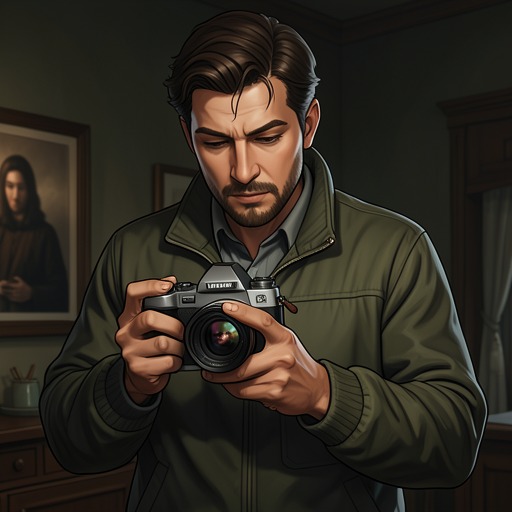
The Earthquake BirdTeiji’s camera is the central object through which the novel binds photography to intimacy, secrecy, and uncertain evidence. It first brings Lucy Fly into Teiji’s way of seeing; later, its pictures become a private archive that she violates, a token in her rivalry with Lily Bridges, and a source of clues in the investigation of Lily’s death. The camera records scenes, but its images do not make their meaning certain: what Lucy believes they show is repeatedly more than what can be established from them.
First Encounter and Intimacy
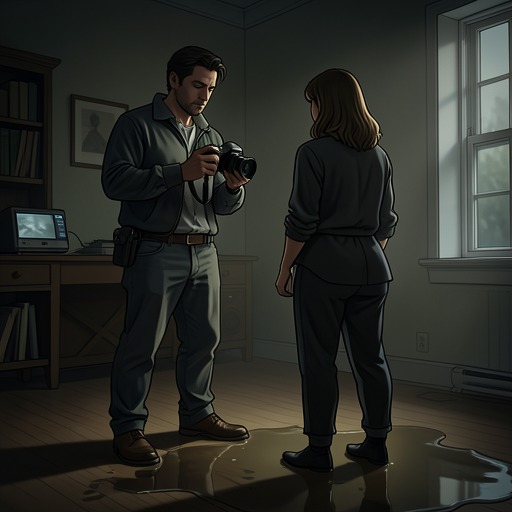
Lucy first sees Teiji outside the Keio Plaza Hotel in Shinjuku, bent over a puddle while rain runs across his hair and face. The camera is trained not on a grand landmark but on dirty water reflecting the hotel: bright windows and lights divided from darkness and floating cigarette ends. Lucy steps forward until her shoes enter the puddle’s reflection. Teiji photographs the water with her feet in the frame, then raises his eyes to her before looking at her through the viewfinder and taking the first pictures of her. Lucy never sees those photographs. Their absence matters: she remembers entering his image, but cannot inspect the image that began their connection or know exactly how he represented her.
At Teiji’s apartment in Shin-Okubo, the camera’s attention becomes part of their sexual intimacy. In the open-curtained room, under lamplight, he takes a final photograph of Lucy’s naked body as she kneels on the bed. She welcomes being seen through the lens, which seems kinder to her than an unaided gaze because it cannot blink or sneer while the picture is being taken. That comfort is shadowed by the knowledge that judgment may come later, when the film is developed. The camera thus offers a form of looking that feels less exposed even as it fixes her body in an image she does not control.
The following morning, Lucy writes her address on a scrap of paper and leaves it beneath the camera. She omits her telephone number because she wants Teiji to seek her out. A week later, when he visits, her memory of what was said and how they came together is uncertain; she imagines that they may have moved straight to lovemaking and that he may have photographed her again. The camera is tangible in her account where speech and sequence are not. It becomes a recurring point of contact in a relationship whose origins Lucy can recall only partially.
A Private Archive
Teiji continues to photograph Lucy, but the camera is not simply a device for making pictures for her. When she asks why he takes so many photographs if he neither sells them nor displays them, he answers that he tries to give her pictures he thinks she will like. The remark establishes a personal exchange, but not an open archive: Lucy knows that images are being made and sometimes given, while the larger collection remains out of view. His apartment contains several cameras and boxes of camera-shop envelopes, yet no photographs displayed on the bare walls.
That separation between taking pictures and allowing them to be seen becomes a point of conflict. Lucy returns to Teiji’s apartment about twenty minutes after he has left, retrieves a spare key hidden in a crack beside the door, and searches the boxes without permission. One contains photographs of his childhood; another chronicles his life in Tokyo. Moving through the latter, she finds a sequence of pictures of a young woman. The woman first appears as an actor in a soldier’s costume on a small theater stage, then in later images at theaters, coffee shops, parks, parties, and on a bed. Across the sequence, the settings and clothing change, and Lucy reads the woman’s face as increasingly sad and worn. The last image she sees shows the woman lying face-down on pavement, her expression impossible for Lucy to distinguish as a grimace or a smile. Lucy speculates about what the pictures mean, but the photographs themselves do not tell her the woman’s identity or explain the circumstances of the final scene.
Teiji enters silently and tells her the pictures are private. Lucy is caught looking through an archive he had not chosen to share. She apologizes for being discovered, while admitting in her recollection that she is not sorry she looked. The camera’s collection therefore marks a limit in their intimacy: Lucy has been photographed by Teiji and has received some pictures from him, but that access does not give her permission to the rest of his life.
Pictures Shared and Taken
When Lily visits Lucy and Teiji at the noodle shop, Teiji serves the two women bowls of noodles and places lacquer chopsticks in Lucy’s hand instead of letting her use the disposable ones. His camera hangs around his neck on its old leather strap. While he works, he suddenly photographs Lucy and Lily together. He gives the print to Lucy a couple of weeks later, wrapped in carefully folded newspaper. The paper carries an article about domestic abuse on one side and foreign-exchange rates on the other; Lucy searches for a message in the choice of wrapping but recognizes that no message was intended.
Lucy’s response to the gift reveals that she does not experience the photograph as a neutral record of both friends. Teiji has not made a copy for Lily, and Lucy takes this as a childish advantage: she reads the picture as herself with Lily included, rather than the two women represented as equals. She keeps it in a box for things she cannot bring herself to discard, though she knows Lily would have liked a copy and does not arrange one. In retrospect, Lucy calls the taking of the photograph the beginning of trouble. The print shows only the women at a table; for her, it is the shutter’s act and the shift she associates with it, not any visible feature in the image, that carries the portent.
The camera changes hands briefly during a drunken night in Yoyogi Park. As the group prepares to leave, Lucy notices that Teiji has left it on the ground, something he never normally does. She picks it up, intending to return it when he notices it is missing. Instead, she removes the lens cap, raises it to her eye, and photographs Teiji and Lily walking ahead while singing. They continue without noticing the flash. Lucy soon puts the camera away and hurries after them, suddenly feeling that she must return it. She later suspects that this photograph, rather than the noodle-shop picture, marked her downfall, but immediately qualifies that belief as possibly superstition: she may be searching for clues where none exist. The camera makes Lucy an observer of the pair at the very moment she feels most threatened by what she observes.
Evidence, Absence, and Aftermath
The camera’s operation is usually woven into Teiji’s movements, but after Lucy tells him about Brian Church, his photographing of her changes. The next day, on their walk to the station, he takes her picture, yet the shutter no longer seems like an unconscious part of his movement. He looks through the viewfinder, shifts about, frowns, and finally takes the picture with visible resignation. Lucy cannot know what has altered in his mind. She considers several possibilities, including the age difference between her and Brian Church and Teiji’s reaction to learning about her past. The altered act of photographing registers distance between them without explaining its cause.
On the trip to Sado Island, Teiji puts a new roll of film into the camera and quickly photographs Lucy and Lily mounting their mopeds. Later, after Teiji leaves Tokyo for Hokkaido, he leaves a note at the noodle shop held down by a roll of undeveloped film. Soutaro has the film developed, hoping the pictures will provide a clue. Instead, he finds deserted beaches, railway tracks without trains, boarded-up buildings, and abandoned trash cans. He turns the photographs upside down and looks at them through old three-dimensional spectacles, but they offer no message he can read. He eventually throws them away and sells the shop. Here, the camera’s archive survives its maker’s departure but cannot explain it; images of emptiness become the only trace Soutaro has to examine.
After Lily’s murder, photographs arrive at the police following the publication of details about Lucy in national newspapers. One shows Lily at a McDonald’s near Lucy’s home, two hours after Lily was seen at Lucy’s front door. A cashier recalls that Lily and her Japanese male companion seemed distressed and had difficulty communicating; Lily left her cheeseburger untouched but drank her Coke. A second photograph shows a woman confined between close brown walls, her head lolling and her eyes empty. The police cannot establish who took either picture or identify the photographer as Teiji. Lucy believes he took them, but the images do not prove that he killed Lily. They do, however, establish that Lucy did not kill her: the first places Lily alive elsewhere after Lucy’s brief venture outside, while the second offers another disturbing image without resolving what it depicts or who made it.
The camera’s sound persists beyond the known photographs. Near the end, as Lucy recalls Lily and the unidentified remains found in the bay, she hears rustling in the trees and then the unmistakable click of a camera followed by the whirr of film advancing. She looks for Teiji but sees only trees and bushes; the clicking seems to echo around the park in every direction. Rain begins as she turns toward the house, and she feels that Teiji is waiting outside, though she cannot see him. The camera is no longer simply a visible object in someone’s hands. Its sound makes photographic attention feel like a presence that may be near or imagined, leaving Lucy between the shelter of home and the fear of being watched.